Truck Accident Liability: Who May Be Responsible and How Insurance Claims Are Affected
Learn how responsibility may be investigated after a commercial truck accident, which parties can become relevant, and how fault and evidence can affect an insurance claim.
When a commercial truck is involved in an accident, identifying the person who was driving is usually straightforward. Determining who may ultimately be responsible for the resulting losses can be considerably more complicated.
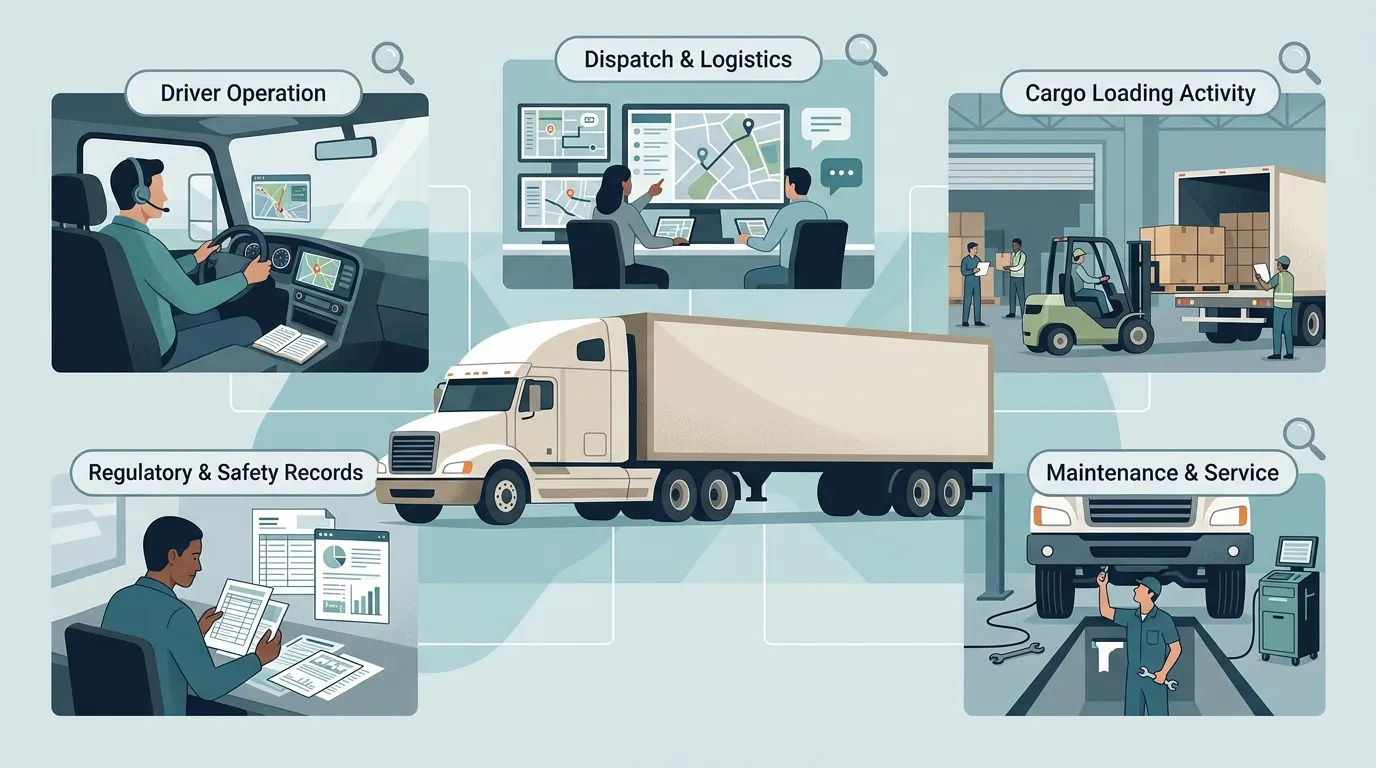
A commercial truck may be driven by an employee or contractor, operated under a motor carrier's authority, owned or leased by another business, loaded by a separate company, and maintained by an outside service provider.
That does not mean every truck accident involves several liable parties. Often, the evidence points mainly to one driver or one business.
The important question is what actually caused the collision and which person or organization was responsible for that part of the trucking operation.
Liability Starts With the Cause of the Accident
The involvement of a commercial truck does not automatically establish fault.
An investigation generally begins with the events leading up to the collision.
Relevant questions can include:
- Which vehicle had the right of way?
- Were applicable traffic laws followed?
- Was a driver distracted or impaired?
- Was anyone driving too fast for the conditions?
- Could driver fatigue have contributed?
- Did a mechanical problem affect the vehicle?
- Did cargo shift or fall?
- Did another road user contribute to the collision?
- Were applicable commercial-vehicle safety requirements followed?
Commercial motor carriers and many commercial drivers are also subject to federal safety rules covering areas such as hours of service, vehicle maintenance, driver qualifications, and cargo securement.
A safety-rule violation can become relevant evidence, but it should not automatically be treated as proof of civil liability. The connection between the conduct and the accident still matters, and the legal effect can vary by jurisdiction.
The Truck Driver
The driver's conduct is often one of the first areas examined.
Depending on the circumstances, investigators may consider issues such as:
- speeding
- unsafe lane changes
- following too closely
- failure to yield
- distraction
- impairment
- fatigue
- failure to perform an inspection where required
- other unsafe driving conduct
Federally regulated commercial drivers can also be subject to FMCSA hours-of-service rules that limit driving and on-duty periods and require specified rest time.
Whether a particular rule applies depends on factors such as the type of operation, vehicle, trip, and any applicable exception.
The driver may therefore be an important part of the liability investigation, but focusing only on the person behind the wheel can overlook other parts of the commercial operation.
The Motor Carrier or Trucking Company
The motor carrier can become relevant for more than one reason.
Depending on the facts, working relationship, and applicable state or federal law, questions can arise about the carrier's own conduct or its relationship with the driver.
An investigation might examine:
- driver qualification
- training
- supervision
- dispatch practices
- compliance with applicable safety requirements
- vehicle inspection and maintenance procedures
- responses to known safety problems
The existence of an accident does not prove that the motor carrier failed in any of these areas. Records and other evidence are needed to establish what occurred.
Insurance can also make the carrier's role important. Certain federally regulated entities seeking or maintaining operating authority are subject to financial-responsibility requirements that differ according to the type of entity, operating authority, cargo, and vehicle.
For readers who want background on those policies rather than liability itself, read our guide on commercial auto insurance.
Cargo Loading and Securement
Some truck accidents involve questions about cargo rather than, or in addition to, the driver's actions.
Cargo can affect vehicle stability, braking, and handling. A load that shifts or falls can also create a roadway hazard.
Federal FMCSA cargo-securement rules apply to covered cargo-carrying commercial motor vehicles operating in interstate commerce and are intended to prevent applicable cargo from shifting or falling from the vehicle.
When cargo may have contributed to an accident, investigators could consider:
- who loaded the cargo
- who was responsible for securing it
- whether the driver had an inspection responsibility
- whether the load shifted
- whether securement equipment was appropriate and in usable condition
- whether the cargo affected vehicle control
Responsibility depends on the actual roles and conduct of the driver, motor carrier, shipper, loader, or other involved parties.
A company should not be assumed liable merely because it handled the cargo.
Maintenance and Mechanical Problems
Mechanical condition can also become relevant.
If an accident involves suspected brake problems, tire failure, steering issues, defective lighting, or another vehicle condition, maintenance and inspection records may help explain what happened.
Potentially relevant information can include:
- inspection reports
- maintenance schedules
- repair invoices
- driver inspection records
- records of previously reported defects
- repairs performed shortly before the accident
Applicable federal rules impose inspection, repair, and maintenance obligations on covered commercial motor vehicles.
But identifying a mechanical failure does not automatically identify the responsible party.
Investigators may need to determine whether the condition existed before the crash, whether it should reasonably have been discovered, who was responsible for maintenance, and whether previous repair work was connected with the failure.
A repair provider does not become liable simply because it previously worked on the truck.
Vehicle or Component Defects
In some cases, the investigation may focus on whether a vehicle or component was defective rather than poorly maintained.
Possible areas of investigation might include:
- tires
- brakes
- steering components
- coupling equipment
- other vehicle systems
Product-related liability is different from ordinary negligent-driving claims.
A component found damaged after an accident does not establish that it was defective before the collision or that it caused the crash. Technical analysis may be needed to distinguish pre-existing failure from damage caused by the impact itself.
Product-liability rules are also jurisdiction-dependent, so a national article should not assume manufacturer responsibility simply because equipment failed.
Another Driver or Road User
The truck driver or motor carrier is not always the responsible party.
Another motorist may cause or contribute to an accident involving a commercial vehicle.
For example, evidence may indicate that another road user:
- made an unsafe lane change
- failed to yield
- entered the truck's path unexpectedly
- ignored a traffic signal
- otherwise contributed to the collision
Several road users can also share responsibility.
That becomes particularly important because state laws differ in how they treat shared fault.
What If More Than One Party Shares Fault?
Truck accident liability is not always an all-or-nothing determination.
Evidence may show that the conduct of more than one person contributed to the collision.
States use different frameworks for allocating fault. Depending on the jurisdiction, compensation may be reduced according to a claimant's share of responsibility, or a different and potentially more restrictive rule may apply.
There is no single nationwide fault percentage that can safely be applied to every truck accident lawsuit.
For a real claim, the current law of the applicable state matters.
How Liability Affects the Insurance Claim
Determining fault is closely connected with determining which insurance coverage may respond.
Once potentially responsible parties have been identified, an insurance investigation may involve questions such as:
- Which insurer covers the truck?
- Was the driver covered by the relevant policy?
- Was another business separately insured?
- Are several policies potentially relevant?
- Is there a coverage dispute or exclusion?
- What policy limits are available?
- Is another road user also involved in a claim?
Commercial motor-carrier financial-responsibility requirements are not identical for every operation. Federal requirements distinguish between different types of regulated entities and activities rather than imposing one universal insurance requirement on every commercial truck. See the FMCSA insurance filing requirements for more information on the federal rules.
The amount of insurance available is important, but insurance limits do not determine liability.
A large policy does not establish that the carrier was at fault, and it does not guarantee payment of the policy limit.
Likewise, identifying several potentially responsible parties can create additional insurance questions without automatically increasing compensation.
For more details on how these investigations typically begin, review the truck accident insurance claim process.
Evidence Can Change the Liability Picture
Early assumptions about fault can change when additional evidence becomes available.
Depending on the accident, relevant information may include:
- police reports
- witness accounts
- scene photographs
- dashcam or fleet-camera video
- electronic logging records
- available onboard vehicle data
- driver qualification information
- dispatch records
- maintenance and inspection records
- cargo records
- repair or engineering evidence
Not every record matters in every case.
Cargo documentation may be central to an accident involving a shifted load and irrelevant to an unrelated lane-change collision. Maintenance records can be critical when mechanical failure is alleged but add little when the cause is clearly unrelated to vehicle condition.
Evidence is useful because it helps connect a theory of responsibility to what actually happened.

Does a Safety Violation Automatically Establish Liability?
Not necessarily.
A regulatory violation may be important evidence, particularly when the rule addresses the same risk involved in the collision.
But there is a difference between identifying a safety violation and establishing civil liability for a specific accident.
The relationship between the conduct and the accident matters.
For example, evidence of an unrelated compliance issue may carry very different significance from evidence that a particular safety failure directly contributed to the collision.
The legal treatment of regulatory violations can also differ by jurisdiction.
Do not assume that finding an FMCSA violation automatically establishes fault or guarantees compensation.
How a Liability Dispute Can Affect Settlement
A claim supported by clear evidence of responsibility may be easier to evaluate than one involving conflicting accounts or several competing explanations.
When liability remains disputed, insurers may disagree about:
- what caused the accident
- how responsibility should be allocated
- whether their insured bears responsibility
- whether claimed losses resulted from the collision
- which insurance coverage applies
Those disagreements can affect both the time needed to resolve the claim and the truck accident settlement process that follows.
Liability and Claim Value Are Different Questions
Identifying a responsible party does not by itself determine the amount of an insurance claim.
The claimant still needs to establish the losses for which compensation is being requested.
Depending on the circumstances and applicable state law, those losses may include:
- medical expenses
- vehicle or property damage
- documented lost income
- supported future treatment needs
- other legally recognized damages
The size or appearance of a collision does not establish the value of truck accident compensation.
Likewise, a high commercial insurance limit does not create losses that did not occur.
Liability answers one question: who may be responsible?
Damages answer another: what compensable loss resulted?
Both are important.
When Professional Advice May Be Useful
Some accidents can be handled through an ordinary insurance investigation.
Others may involve:
- serious injuries
- several businesses
- multiple insurers
- disputed responsibility
- cargo issues
- mechanical questions
- commercial records
- questions involving state and federal rules
Professional legal advice may be useful in a complicated case, particularly where there are questions about applicable state law, filing deadlines, evidence preservation, or which parties may be legally responsible.
FinanzVault does not provide legal representation. This article is general educational information and should not be treated as a legal determination about an individual accident.
The practical point is straightforward: the name on the truck, the person behind the wheel, and the size of an insurance policy do not necessarily tell the entire story.
Truck accident liability follows the evidence.
Understanding what caused the collision, who controlled the relevant parts of the trucking operation, and which rules apply provides a more useful basis for an insurance claim than assigning blame before the facts are known.
Published by FinanzVault Editorial Team
FinanzVault provides independent, educational finance guides and transparent calculation tools. Our content is thoroughly researched, fact-checked against official financial data sources, and designed to help you make informed decisions.
Related Financial Guides

Truck Accident Settlement: How the Process Works and What Can Affect the Amount
Learn why truck accident settlement amounts vary, which losses and evidence can affect a claim, how insurance limits matter, and what usually happens during settlement negotiations.