Truck Accident Settlement: How the Process Works and What Can Affect the Amount
Learn why truck accident settlement amounts vary, which losses and evidence can affect a claim, how insurance limits matter, and what usually happens during settlement negotiations.

Searching for an "average truck accident settlement" can make it sound as though there should be one reliable number.
There usually is not.
A settlement is based on the facts of an individual claim: the injuries involved, medical costs, time away from work, long-term effects, available insurance, evidence of responsibility, state law, and whether any part of the claim is disputed. A thorough truck accident insurance claim investigation helps clarify these factors before negotiations begin.
Two accidents involving similar trucks can therefore produce very different outcomes.
That does not make settlement value completely unpredictable. It means the useful question is not "What is the average payout?" but "Which parts of this particular claim affect its value, and how does the settlement process work?"
Why an Average Truck Accident Settlement Can Be Misleading
There is no comprehensive public database containing every negotiated truck accident settlement in the United States.
Many claims are resolved without a public trial, and individual settlement terms may not become part of a searchable court record. Published verdicts and highly publicized settlements also tend to represent unusual or more serious cases rather than a representative sample of all claims.
That creates a problem with online "average settlement" figures.
A number may be based on:
- a small collection of cases
- law-firm marketing results
- jury verdicts mixed together with settlements
- particularly severe injuries
- claims from only one state or jurisdiction
- cases with unusually high insurance limits
Those figures can create unrealistic expectations.
There is also no universal "minimum truck settlement."
The amount of insurance available can affect how much may realistically be recovered through insurance, but a policy limit is not a guaranteed payout. A claim still has to be supported by the facts, applicable law, covered damages, and available evidence.
What a Truck Accident Settlement Is Intended to Resolve
A settlement is an agreement that resolves some or all of the claims arising from an accident without requiring a final court judgment on those issues.
In exchange for payment, the claimant typically signs a release affecting the right to pursue further claims covered by the agreement.
That release is important.
Once a claim has been finally settled and released, reopening it later can be difficult or impossible even if additional consequences become apparent afterward.
This is one reason serious injury claims are often evaluated only after there is enough medical information to understand the likely course of recovery.
The details of releases and settlement agreements vary, so anyone considering a significant final settlement should understand exactly what rights are being given up.
What Can Affect a Truck Accident Settlement Amount?
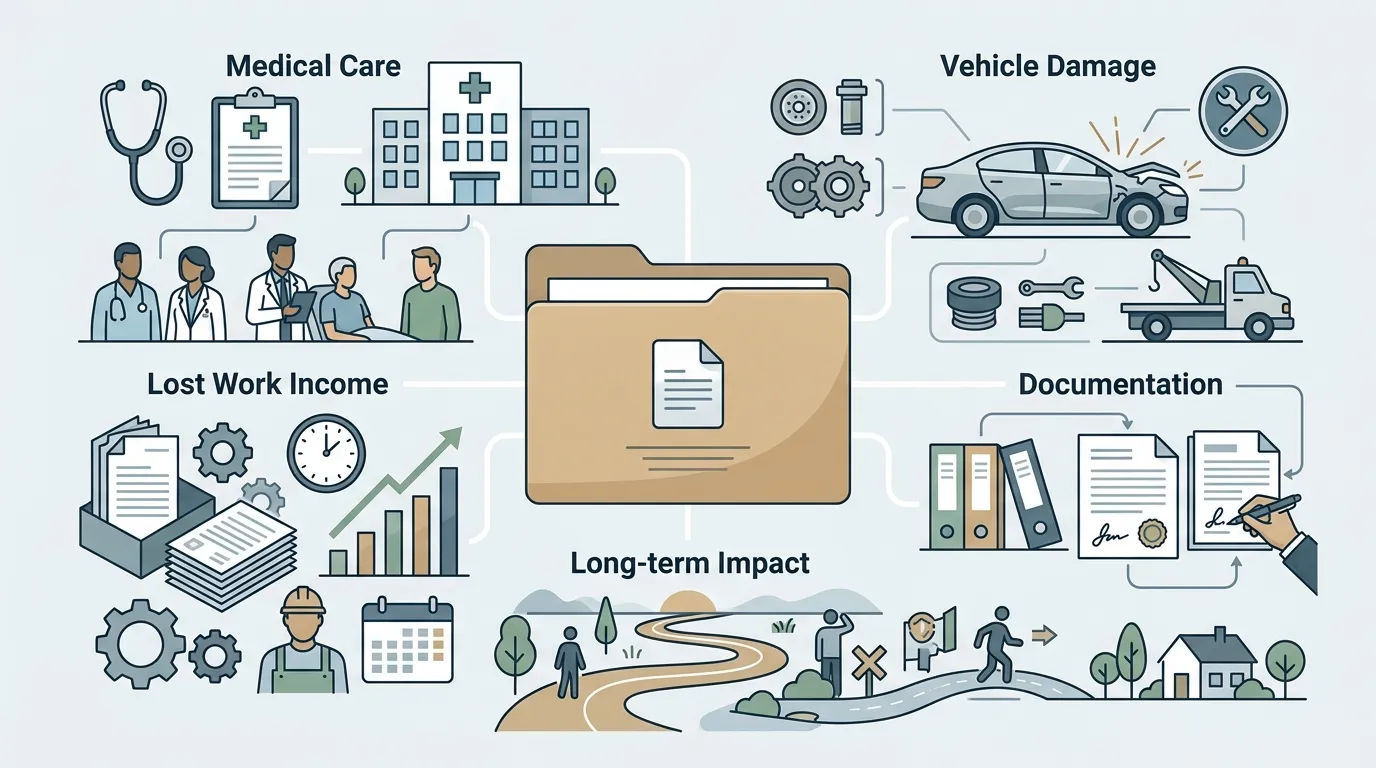
Settlement value usually develops from several different parts of the claim rather than one formula.
Medical expenses and future care
Medical costs can form a major part of an injury claim.
Relevant documentation may include:
- emergency treatment
- hospital care
- diagnostic testing
- physician visits
- physical therapy
- medication
- surgery
- rehabilitation
- reasonably supported future treatment
Past expenses are easier to document than future care.
When future treatment is claimed, the supporting medical evidence becomes especially important because an insurer may challenge costs that appear uncertain or unrelated to the accident.
Lost income and reduced earning ability
An injury can affect income in more than one way.
Someone may miss several days or weeks of work during recovery. A more serious injury may affect the ability to return to the same job, work the same hours, or earn at the same level in the future.
Supporting information can include:
- wage records
- employer documentation
- tax or earnings records where relevant
- work restrictions
- medical evidence concerning future limitations
Claims involving long-term earning capacity are usually more complex than claims involving a short period of missed work.
Property damage and other documented expenses
A claim may also include damage to a personal vehicle and other property.
Depending on the circumstances and applicable law, additional documented expenses connected with the accident can also become relevant.
The key point is documentation.
An insurer can evaluate a repair invoice or receipt more easily than an unsupported estimate of a loss.
Pain, limitations, and other non-economic harm
Not every consequence of an injury appears on a bill.
Depending on applicable law, a claim may also involve non-economic losses such as:
- physical pain
- loss of normal activities
- permanent limitation
- scarring or disfigurement
- significant effects on daily life
These losses do not have one nationally accepted calculation formula.
Avoid treating online "multiplier" or "per diem" formulas as rules that automatically determine settlement value.
Insurers, attorneys, mediators, and courts may evaluate non-economic harm using the specific medical evidence, severity, duration, permanency, credibility of the documentation, jurisdiction, and other facts of the case.
Punitive damages in unusual cases
Punitive damages are different from compensation for ordinary losses.
They are generally tied to especially serious misconduct and are available only when the applicable law and facts allow them.
Standards vary significantly by jurisdiction.
Do not assume punitive damages apply simply because a commercial truck was involved or because an accident caused serious injuries.
Liability Can Change the Value of the Claim
Damages are only one side of a settlement evaluation.
The other major question is responsibility.
A claim supported by strong evidence of another party's responsibility may be valued differently from one where fault is genuinely disputed.
Relevant evidence can include:
- police reports
- scene photographs
- witness information
- electronic records
- driver records
- vehicle or maintenance information
- available camera footage
- medical documentation
Truck accidents can also involve more than one potentially responsible party.
Depending on the facts, investigators may examine the conduct of the driver, motor carrier, vehicle owner, maintenance provider, cargo-related parties, or another road user.
That does not mean every accident involves multiple liable parties. Responsibility must be established from the facts and applicable law.
Shared Fault Rules Vary by State
An injured person's own actions can also affect a claim.
States use different rules when more than one person shares responsibility for an accident.
In some jurisdictions, compensation may be reduced according to a person's share of fault. Other jurisdictions apply different or more restrictive rules.
Because those standards are state-specific, a nationwide article should not present one percentage threshold as if it applies everywhere.
For a real claim, the applicable state's current rule matters.
Insurance Limits Matter, but They Do Not Set the Settlement
Commercial motor carriers can be subject to financial-responsibility requirements that differ from ordinary personal auto insurance. For background on these coverages, business owners and claimants often review how commercial auto insurance operates.
The applicable requirements depend on factors such as:
- type of carrier
- interstate or intrastate operation
- vehicle weight
- passengers
- hazardous-material transportation
- other regulatory classifications
Some federally regulated motor carriers must maintain substantially more financial responsibility than an ordinary personal driver. These details are outlined in the 49 CFR Part 387 regulations and the corresponding FMCSA insurance filing requirements.
That can mean more insurance is potentially available in a serious truck accident claim.
But available coverage and claim value are different concepts.
A large policy does not mean a claimant automatically receives the policy limit.
Likewise, documented damages can sometimes exceed the amount available under a particular policy, which can create additional legal and financial questions.
How Settlement Negotiations Usually Begin
Settlement discussions often become more meaningful after the accident has been investigated and the losses are reasonably documented.

In an injury claim, that may mean waiting until doctors have a clearer understanding of recovery, ongoing treatment, and possible long-term effects.
A negotiation may involve:
- gathering supporting records and evidence
- presenting the claimed losses to the insurer
- receiving the insurer's evaluation or offer
- discussing disputed parts of the claim
- exchanging further information or counteroffers
- reaching an agreement or deciding that no agreement is possible
There is no required number of offers or counteroffers.
Some claims resolve quickly. Others remain disputed for months or longer.
Why an Initial Offer and a Final Settlement May Differ
An insurer's first offer is not necessarily its final position.
Disagreements can involve:
- responsibility for the accident
- whether treatment was related to the crash
- whether medical expenses were reasonable
- expected future care
- lost-income calculations
- non-economic harm
- insurance coverage
- shared fault
Additional documentation can sometimes narrow those disagreements.
In other cases, the parties remain far apart and may use mediation, litigation, or another dispute-resolution process.
Do not assume that every first offer is unfair or that rejecting an offer automatically produces a better one.
Why Settling Too Early Can Create Risk
The pressure to resolve a claim quickly can be understandable.
Medical bills, vehicle costs, missed work, and uncertainty can create a strong desire for closure.
The problem is that the future consequences of a serious injury may not be clear immediately.
If a final settlement includes a broad release and later treatment becomes necessary, the claimant may not be able to return and demand additional payment for the same released claim.
Before agreeing to a final resolution, it is important to understand:
- whether treatment is complete or still developing
- whether future medical care is reasonably expected
- whether work restrictions may continue
- what the release covers
- whether liens or reimbursement obligations exist
- which claims are being resolved
The Settlement Amount Is Not Always the Amount You Keep
The gross settlement figure and the amount ultimately received by the claimant can be different.
Potential deductions or obligations may include:
- attorney fees under an agreed fee arrangement
- litigation or case expenses
- certain medical-provider claims
- health-plan reimbursement rights
- Medicare coordination and recovery rules where applicable
- other valid liens or reimbursement claims
Not every claim involves all of these items.
The rules can depend on the type of health coverage, settlement allocation, jurisdiction, and individual circumstances.
Do not present one universal percentage for attorney fees or liens.
Tax treatment can also vary depending on what the settlement compensates for. Do not add a blanket statement that every personal-injury settlement is either taxable or tax-free.
How Long Can a Truck Accident Settlement Take?
There is no reliable universal timeline.
A relatively straightforward property-damage claim may resolve much faster than a claim involving surgery, permanent injury, disputed responsibility, or several potentially responsible parties.
Factors that can lengthen the process include:
- ongoing medical treatment
- uncertainty about future recovery
- disputed fault
- multiple insurers
- complex commercial records
- difficulty obtaining evidence
- disagreement over damages
- litigation
Speed is not always the best measure of whether a claim is progressing properly.
In a serious injury case, waiting for a clearer medical picture can sometimes provide information necessary for a more accurate evaluation.
Documents That Can Help Support a Settlement Evaluation
Organized records can make it easier to understand what a claim actually involves.
Depending on the situation, useful records may include:
- accident or police report information
- photographs
- medical bills
- treatment records
- repair estimates
- proof of lost income
- receipts for relevant accident-related expenses
- insurance correspondence
- claim numbers
- witness information
- records showing work restrictions
- relevant commercial-truck evidence obtained during the claim
The goal is not to collect paperwork for its own sake.
Documentation should connect the claimed loss to the accident and help explain the amount being requested.
When Professional Advice May Be Useful
A minor claim involving limited damage and clear responsibility may be manageable directly with insurers.
Professional legal advice may become more useful when a claim involves:
- serious or permanent injury
- several potentially responsible parties
- disputed liability
- complex commercial insurance
- significant future medical care
- substantial income loss
- questions about liens or reimbursement
- an unclear filing deadline
- a proposed release with significant long-term consequences
A lawyer can explain how the rules in the relevant jurisdiction apply to a specific case.
FinanzVault does not provide legal representation, and this article is general educational information rather than legal advice.
Focus on the Facts, Not an Online Average
Truck accident settlements can vary widely because truck accident claims vary widely.
A reliable evaluation looks at the actual injuries, financial losses, evidence, liability, insurance coverage, state law, and long-term effects rather than trying to force the claim into a national average.
That also explains why a dramatic settlement figure found online may tell you very little about another person's case.
The more useful approach is to document the losses carefully, understand what insurance is available, identify any disputed issues, and evaluate a proposed settlement in light of the facts that actually apply.
Published by FinanzVault Editorial Team
FinanzVault provides independent, educational finance guides and transparent calculation tools. Our content is thoroughly researched, fact-checked against official financial data sources, and designed to help you make informed decisions.
Related Financial Guides

Truck Accident Liability: Who May Be Responsible and How Insurance Claims Are Affected
Learn how responsibility may be investigated after a commercial truck accident, which parties can become relevant, and how fault and evidence can affect an insurance claim.